Overview
Condensation
causes corrosion, rust, mould, mildew, fungus, swelling and
spoiling of product integrity.
The diagram below represents a packed 20ft shipping container
and highlights the main sources of moisture. The cargo has
been stacked on pallets.
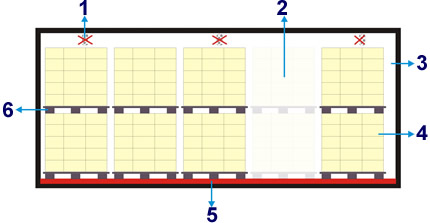
- Containers are fitted with ventilation
holes, normally 6 for a 20ft container . This allows moisture
to enter/exit the container. ideally these holes should
be sealed for better control when desiccants are used.
- Cargo takes up free space in the
container. This will decrease the volume of atmospheric
moisture entering the container.
- The volume of a 20ft container
is 33m³. At 20ºC and 80% relative humidity this
equates to almost 850ml of airborne moisture.
- Cargo and packaging materials such
as paper, board and cardboard are a source of moisture.
- in containers with wooden floors,
the floors themselves are a major source of moisture. Wooden
floor areas allow for faster moisture release than that
of wooden pallets. Careful consideration should be given
to managing this risk.
- Wooden pallets are one of the
major contributors of moisture. Wood tends to have a moisture
content that is in equilibrium with atmospheric conditions.
A pallet with 20% moisture content could release as much
as 3.5 litres of moisture inside a container.
Factors Affecting Condensation
- The weather during the voyage
- The duration of the voyage
- Type of goods, commodities or
materials in the container
- The condition of the container
- The sensitivity of the goods
- The moisture content of the floor
and/or wooden pallets and/or packaging material
|



